Imbolc | The Portal of Rebirth, Creative Energy, and Protection
The Bright Return
All around the globe there are stories and myths related to the coming of Spring.
Getting through the dark of Winter can be trying for many, and so at this time in February the festival of Imbolc is really that first glimmer above ground that life is returning. The coming of Spring brings hope, for not only does the return of Spring bring new life to the land, but it also signals the Soul to come out of the darkness and into the light.
At Samhain, we said goodbye to that which no longer served us and welcomed in the Cailleach, the formidable Crone and teacher of the darkness. Then at Solstice, we dived down to the deepest dark and there, the spark of light ignited with conception and the beginning of change. This was the time that we nurtured these glimmers of new things.
As we come then to Imbolc, we are heralding the coming of that change, and the powerful regenenerative energy of Brighid .
When is Imbolc?
Imbolc is often celebrated on February 1 according to the Gregorian calendar. However, the actual day of Imbolc is based on the cosmos, not on the calendar. Imbolc is the halfway point between the Winter Solstice and the Spring Equinox.
What is Imbolc?
Imbolc is the Celtic Fire Festival of new life, pregnancy, rebirth, transformation. Unlike the Airts (seasonal four winds) where the ancient guiding energies prevail for a whole season, these cross-quarter festivals between the solstices and equinoxes are very powerful doorways, open for about 3-4 days. They provide an opportunity to do some potent magic depending on the intention of the festival.
The name Imbolc translates as “in the womb” or “in the belly” and sometimes as ewe’s milk or first milk (oi melc in Gaelic.) This sacred festival was designed to coincide with the birth of the spring lambs and the lactating of the ewes. White was often the colour used to reflect this time as it’s not only the colour of the sheep, but also of the snowdrops, the first flowers of Spring, and the melting snow and the frost.
Even though it’s still really cold and it doesn’t feel like spring, Imbolc is a messenger of hope reminding us that life always returns after stillness.
Because Imbolc is the very beginning, it can often be a quieter threshhold where we simply sit quietly with a single candle and begin sending energy and intentions to the seeds we uncovered at Solstice. The details aren’t as important as the intention.
Springs and wells are a big part of the Celtic cosmology and hot springs in particular are important at Imbolc because they represent the eternal flame deep down in Mother Earth that heats the waters of inspiration. So, this is a good time to rededicate yourself to your intentions, or even renew vows. It’s also a time when artists, poets, actors and other bards, dedicate and renew their relationship with the Muse Goddess, clearing and renewing their springs of creativity and inspiration, so that the tender shoots of our dreams, desires and hopes can be nurtured.
Seasonal Deities
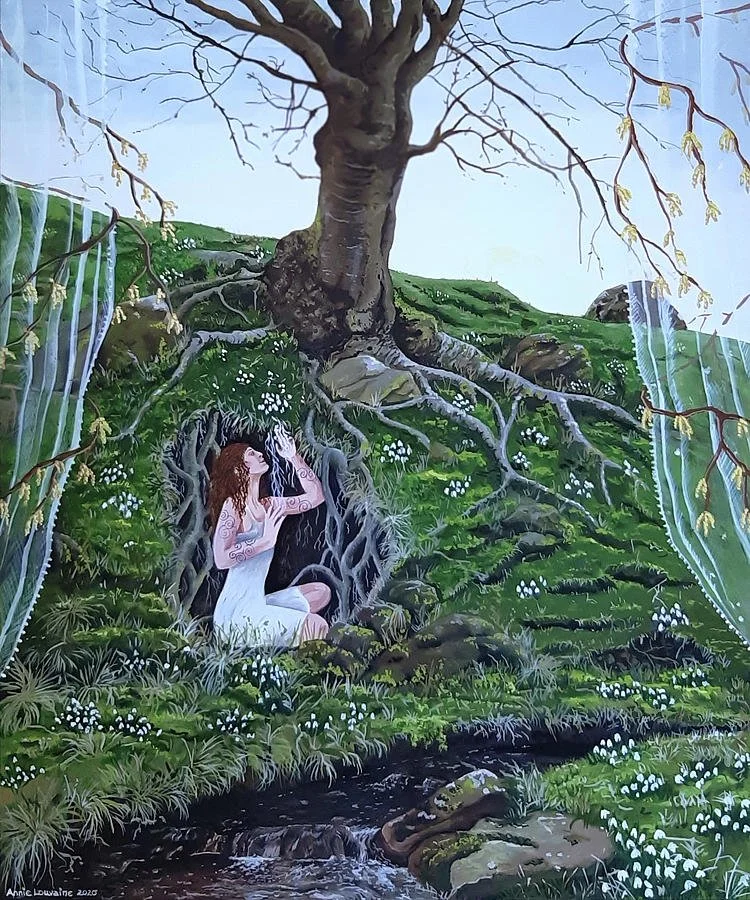
IMBOLC the Maiden Awakens by Annie Louvaine
Two of the deities we celebrate at Imbolc are Brighid and Oisín.
Brighid, also known as the “bright one” or Mary of the Gaels, is an ancient personification of Spring known and celebrated from Austria and all across Western Europe. She represents the old Crone of Winter, reborn and transformed. More than a deity, she is the energy of Spring, fertility, and the power of our Mama Earth as she begins to push forth new life.
Oisín, (young fawn), was connected to the Sidhe, and Tir na nÓg (land of youth) who grew into a legendary poet (shaman) and warrior. He represents the virility of new life that Mama Earth is birthing.
Naturally, we have each of these forces within us, and so Imbolc is a wonderful time to reflect on what you are pregnant with, how you are preparing to birth or fly from the nest, and what you need in place to support and care for all that is new.
Imbolc Traditions
Spring Cleaning
This is the time to give your home a good thorough cleaning in preparation for a visit from Brighid. If you happen to have a fireplace, this is a perfect time to give it a thorough cleaning. As a part of the magical purification of the house you may like to use a Birch branch to symbolically sweep the floors because Birch has strong associations with Brighid, and has long been used for purification and beginnings. Like all Seasonal thresholds, this is also a good time to clean the doorways and thresholds of your home or office. Here’s a video of a Threshold Cleansing Ritual you might like to explore
Brighid's Cross
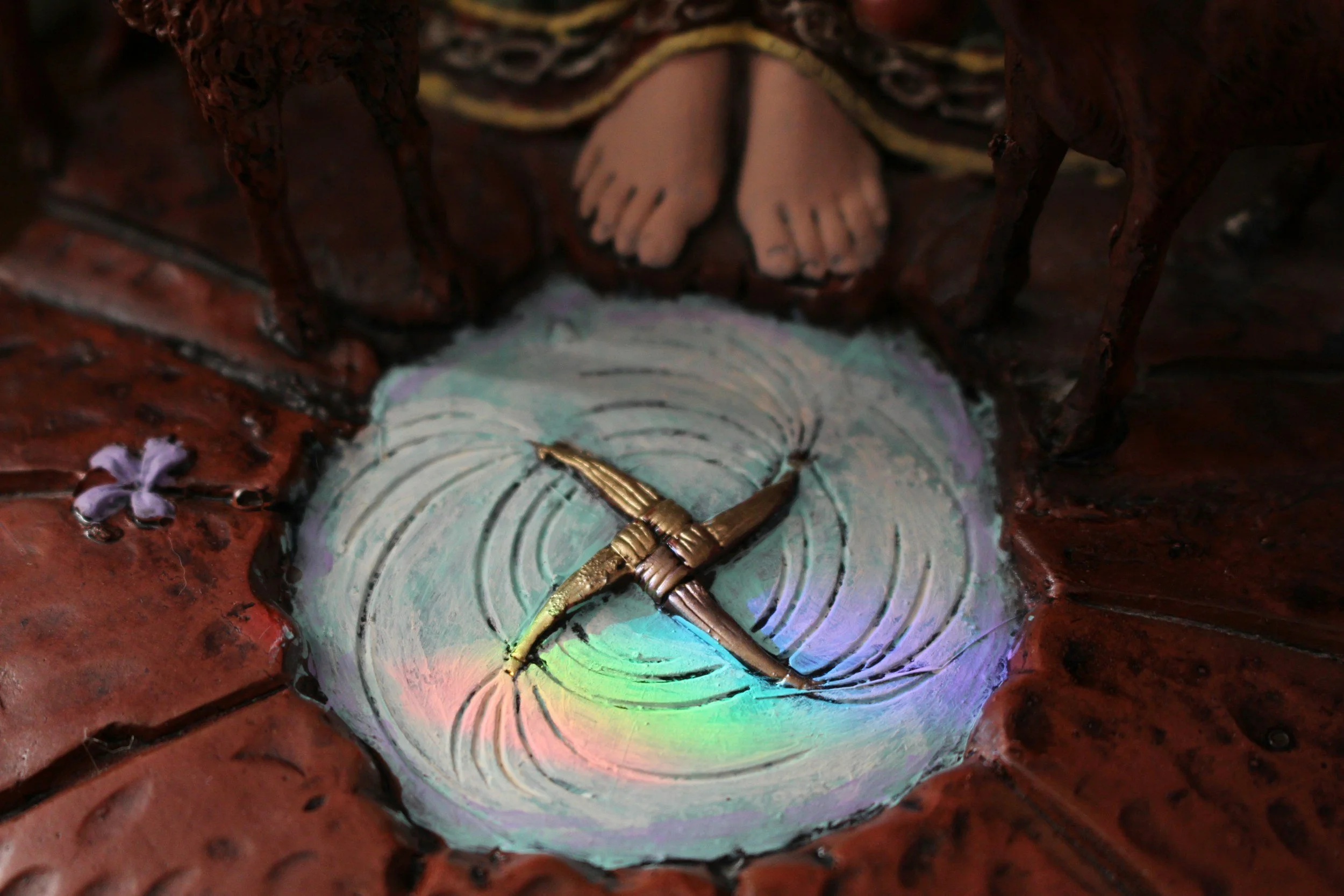
This is the most widely practiced custom associated with Imbolc. For the best results, use straw and soak it in water for a couple of days prior to the feast. The weaving of the Brighid’s cross can be as simple as a few strands or amazingly elaborate. Most folks are familiar with the three or four-armed variety but there is a great number of different regional patterns including what most people in America know as a "God's Eye" pattern woven around two sticks. Once your Brighid’s Cross is made, you can sprinkle it with a bit of sacred water and speak a request of Brighid for blessing and protection of the home and family members. Old crosses from previous years can be moved elsewhere or outside, or placed in the fire as an offering of gratitude, and the new crosses hung in their place over thresholds to your home.
This protection totem of Brighid can be used throughout the year at anytime when you wish to call in protection or the blessing of Brighid. Some times may include: times of illness, calling in a baby as seek conception (tuck it between the mattresses,) placed on the Earth next to you as you plant seeds for the year.
Blessing of the BratACH BridHE
During the day before Imbolc, the woman of the house or women of the grove should take a small piece of cloth (larger if it is for the entire grove) and lay it on a bush outside. During the night, as the goddess roams to bless the houses of her followers, she will pass by, touching and blessing the cloth. Collect the cloth in the morning and tear it into small pieces. These pieces of doth, individually called a Brat Brid (BRAHT BREE]), should be distributed among the children and females of the household. The Brat Brid will give them protection throughout the year where ever they go. These pieces of cloth may be sewn into the clothes or jackets of the children to insure that it won't be lost. Blessing the Bratach Brid The Bratach Bree (BRAH-TOCK BREE) is a large piece of cloth, such as a shawl that Brigit will bless in the same fashion as the Brat Brid. Instead of being torn into pieces on the next day this cloth should be kept as a sacred relic and charged repeatedly year after year. The Bratach Brid can become quite powerful over time and can be used to help insure safe childbirth and to cure sterility by placing it over the patient and asking for Brigit's help. It was once fairly standard equipment for country midwives in Ireland. In addition to being used for human mothers during childbirth it was also spread across the back of birthing cows to ensure the health of the calves and an abundant supply of milk.
May the fertility of Brighid, and the virility of Oisín light the fire of your spirit, encircling you in protection, and enfolding you in love.
In bright connection,
Angela
References
Carmichael. Alexander, Carmina Gadelica Hymns & Incantations, ed. C. J. Moore, Edinburgh; Books. 1992
Danaher, Kevin, The Year In Ireland, Irish Calendar Customs, Minneapolis: Mercier Press, 1972
O Cathainn, Seamas, The Festival of Brigit, Celtic Goddess & Holy Woman, Dublin: DBA Publications Ltd., 1995
Rees, Alwyn and Brinley Rees. Celtic Heritage, Ancient Tradition in Ireland and Wales, London: Thames and Hudson, 1961
http://www.adf.org/core/
Join Me and Experience the Path
Upcoming Events
Check out upcoming workshops, Souledelic Ceremonies and more
Personal Sessions
Book a 15-minute Connection Call, 1:1 Sessions or personalized ceremonies
Apprenticeship
Join the Waitlist. 12-month deep dive. Applications in May, we begin in Sept.